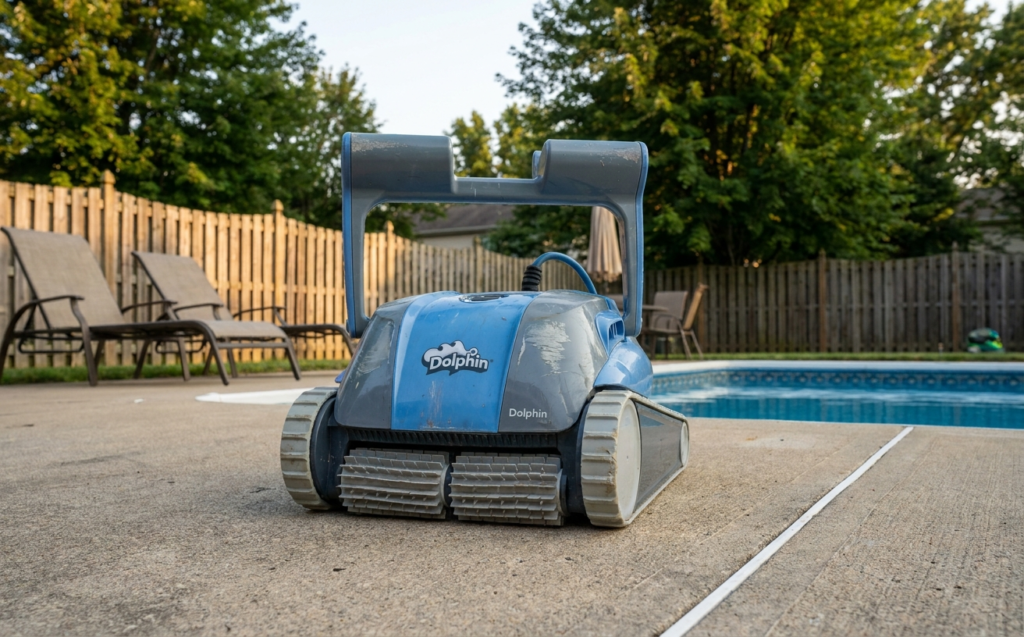

When you first unbox a robotic pool cleaner, every feature feels exciting. The lights, the remote, the app connectivity, the multiple cleaning modes. Six months later, most of those features are forgotten. What remains are the ones that affect your daily experience: how easy it is to clean the filter, whether the cable tangles, and how consistently it covers the pool floor.
The features that matter after year one are the ones that determine whether the cleaner stays useful or becomes a chore. These are the features to prioritize if you want a machine that improves with familiarity rather than degrading with use.
Filter Access Is the Feature You Use Every Time
Every robotic cleaner requires filter cleaning after each use. There are no exceptions. The question is whether this takes twenty seconds or five minutes. Top-access filter compartments that slide out without turning the machine over make the task trivial. Bottom-access compartments that require flipping a wet, heavy machine and removing clips make the task unpleasant enough that you start skipping it.
Skipped filter cleaning leads to reduced suction, which leads to poor cleaning results, which leads to running the machine longer, which leads to more wear. The cascade starts with filter access. A cleaner that makes filter cleaning easy gets cleaned regularly and performs consistently. A cleaner that makes it awkward gets cleaned sporadically and declines.
Test this feature before buying. Open and close the filter compartment. If it requires tools or more than two hands, it will annoy you every time you use it.
Cable Management Determines Your Frustration Level
The cable is the most consistently frustrating part of owning a robotic pool cleaner. It tangles, it catches on ladders and lights, and it can prevent the cleaner from reaching the far end of the pool. Swivel cable connections that allow the cable to rotate without twisting eliminate the most common tangle problem and are worth the additional cost.
Cable length also matters more than most buyers realize. A cable that is too short restricts the cleaner to part of the pool. A cable that is too long creates excess slack that coils and catches on obstacles. Measure the distance from your power outlet location to the farthest point in the pool before choosing a cable length.
How you store the cable between uses affects its lifespan. Coiling it tightly around the power supply creates kinks that stress the internal conductors. Draping it loosely over a hook or laying it flat on the ground preserves flexibility and prevents internal wire breaks that cause intermittent power failures.
Drive System Reliability Shows Up in Year Two
Drive motors and belts work fine when they are new. Problems emerge after hundreds of hours of operation in chemically treated water. Belt-driven systems require periodic belt replacement, which is inexpensive but needs to be done proactively before the belt breaks mid-cycle and leaves the cleaner stranded in the pool.
Direct-drive systems eliminate the belt but put more stress on the motor, which can lead to motor failure in less robust designs. The sweet spot is a belt-driven system with easy belt access, so you can inspect and replace the belt before it fails rather than after.
According to iGarden’s 2026 robotic cleaner guide, the drive system is the component most likely to determine whether a cleaner lasts three years or three months beyond its warranty period. Belt access and motor sealing are more important for long-term reliability than motor wattage or theoretical coverage speed.
Waterline Cleaning: Nice to Have, Hard to Do Well
Cleaning the waterline is the most technically demanding task for a robotic cleaner. It requires transitioning from floor to wall, climbing to the water surface, and scrubbing horizontally along the tile line. Many cleaners claim this capability but perform it inconsistently, especially on textured tile or in pools with uneven wall surfaces.
If waterline cleaning matters to you, look for cleaners with active scrubbing brushes rather than passive foam rollers. Brushes agitate the tile surface and remove the thin film of body oils and sunscreen that accumulates at the waterline. Foam rollers glide over it without removing it.
The practical reality is that no robotic cleaner cleans the waterline as thoroughly as a person with a brush. The question is whether the cleaner does it well enough to extend the interval between manual cleanings. If it reduces manual waterline brushing from weekly to monthly, it is providing real value.
Cycle Options: More Is Not Always Better
Basic cleaners have one cycle: press start and it runs. Advanced cleaners offer floor only, floor and walls, quick clean, and deep clean. The value of these options depends on how often you actually use them.
Most pool owners settle into a routine that uses one or two cycles. Floor-only for regular maintenance, and floor-plus-walls for the occasional deep clean. The other options go unused. Paying for five cycle options when you only use two is not good value.
Weekly scheduling, on the other hand, is a feature that most owners use consistently once they set it up. The convenience of having the pool cleaned automatically on a schedule, without remembering to start the cleaner, is the single most impactful convenience feature for long-term ownership satisfaction.
What to Ignore on the Spec Sheet
Suction power numbers are misleading because they do not account for filter clogging, which reduces suction progressively during each cleaning cycle. A cleaner with moderate suction and a large filter that stays clean longer outperforms a high-suction cleaner with a small filter that clogs quickly.
Coverage claims based on ideal conditions in test pools do not translate to real pools with obstacles, slopes, and irregular shapes. The only reliable coverage metric is consistent real-world performance over months of use.
Smart features like app connectivity and remote control are appealing in the first week and irrelevant by the first month. The cleaner needs to start, run, and stop. A button on the power supply does this reliably for years. Apps require updates, lose compatibility, and add complexity to a task that should be simple.
Focus on the features you interact with every time you use the cleaner: filter access, cable management, and cycle reliability. These determine whether year two is as satisfying as year one, or whether you start shopping for a replacement.