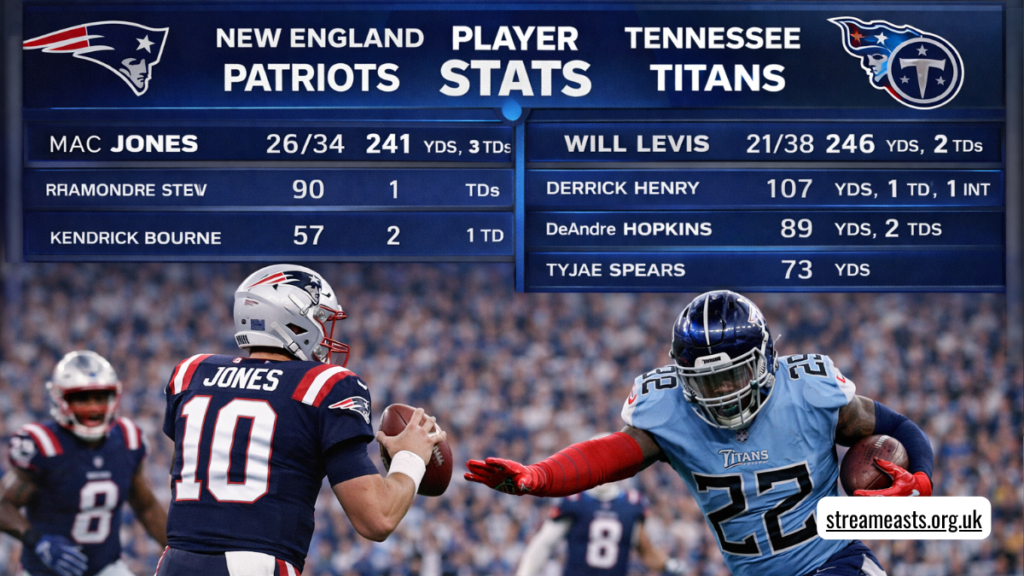

New England Patriots vs Tennessee Titans Match Player Stats: In‑Depth Analysis & Insights
In the world of New England Patriots vs Tennessee Titans match player stats, fans naturally crave granular details that reveal how individual performances shaped the outcome. Whether you’re breaking down rushing yardage, passing efficiency, defensive pressure, or impact plays on special teams, this comprehensive authority article serves as the ultimate resource for understanding not just the final score, but the story told by the numbers.
This page will guide you through every relevant statistical insight from recent Patriots‑Titans matchups, including individual standout performances, comparative metrics across positions, strategic contexts, historical trends, and predictive angles for future encounters. Expect expert explanations, vivid narrative clarity, and real‑world implications behind each performance marker.
Overview of the Latest Patriots vs Titans Match
In a Week 7 clash that captured football analysts’ attention, the New England Patriots vs Tennessee Titans match player stats highlighted a dominant performance by the Patriots that translated to a 31‑13 victory. New England controlled possession, executed efficient scoring drives, and limited Tennessee’s offense through both strategic play‑calling and individual execution.
Patriots quarterback Drake Maye led the statistical narrative with an exceptional passing day, while the Titans’ efforts were hampered by turnovers and inconsistent production on the ground. Team metrics underscore the Patriots’ ability to outperform Tennessee in nearly every offensive and defensive category, revealing deeper trends in how matchups between these franchises unfold.
In‑Depth Passing Stats and Quarterback Performance
Passing performance is often the most scrutinized aspect of NFL game analysis, and in this New England Patriots vs Tennessee Titans match player stats breakdown, quarterback play defined the contest. For New England, Drake Maye completed an astounding 21 of 23 passes for 222 yards and two touchdowns, resulting in a league‑leading completion percentage for that game.
On the Tennessee side, Cam Ward logged 255 passing yards and one touchdown, but his day was inflated by bulk attempts that lacked the same efficiency seen from Maye. An interception and a lost fumble further weighed on the Titans’ passing outcome, underscoring the impact turnovers have on predictive success metrics.
Rushing Leaders and Yardage Breakdowns
In the New England Patriots vs Tennessee Titans match player stats, rushing output told a story of offensive balance for New England and struggles for Tennessee. Rhamondre Stevenson paced the Patriots’ ground game with 88 rushing yards and one touchdown, showcasing his dual threat as both a yardage gainer and red‑zone scorer.
Tennessee’s rushing efforts were stifled overall, with their leading ground producer managing only 39 yards. Effective defensive gap control by the Patriots limited explosive run opportunities, forcing the Titans into more predictable passing situations that New England’s defense could exploit.
Receiving Stats and Air Attack Comparisons
Receiver production paints a nuanced picture in the New England Patriots vs Tennessee Titans match player stats. For New England, Stefon Diggs led receiving with 69 yards on seven catches, while Kayshon Boutte added a 39‑yard touchdown catch that contributed decisively to the scoring margin.
Tennessee’s receiving numbers were more modest. Chimere Dike caught four passes for 70 yards and a touchdown, giving the Titans some offensive sparks despite the larger deficit. This juxtaposition reflects how play‑action and field position dynamics influence receiving stats across teams.
Defensive Standouts and Impact Plays
Defense shapes games as much as offense, and in the New England Patriots vs Tennessee Titans match player stats, New England’s defensive unit made pivotal contributions. K’Lavon Chaisson notched two sacks and returned a fumble for a touchdown, a rare defensive scoring play that swung momentum emphatically.
Patriots defenders recorded multiple tackles behind the line of scrimmage, disrupting rhythm and creating negative‑yardage situations that forced the Titans into third‑and‑long down and distance. The interception by Marcus Jones late in the game further sealed control for New England.
Turnover Impact and Possession Control
Turnovers often serve as tipping points in NFL results, and the New England Patriots vs Tennessee Titans match player stats reflect this universal truth. New England forced two turnovers — an interception and a fumble recovery — that directly correlated with scoring drives and swings in field position.
In contrast, Tennessee’s offense failed to protect the football, with negative turnover differential undermining their statistical output. Time of possession metrics further highlight this imbalance, with the Patriots maintaining control for over 37 minutes compared to Tennessee’s 22 minutes.
Special Teams Contributions
While often overlooked, special teams play can significantly influence overall statistical profiles in any New England Patriots vs Tennessee Titans match player stats evaluation. New England’s kicker contributed consistent field goal scoring, and controlled kickoff placement helped net favorable starting positions.
Tennessee struggled to match this consistency, and missed opportunities on returns and field goals contributed to the scoring gap. In close matches, this component can be the margin of victory — a lesson reinforced by detailed statistical analysis.
Game Flow and Score Progression
Understanding how a game evolved quarter by quarter offers context for raw New England Patriots vs Tennessee Titans match player stats. In the recent matchup, Tennessee initially led 10‑3 in the first quarter, showing early offensive promise. However, New England responded with increased efficiency in the second and third quarters, taking a 31‑13 lead.
This progression highlights how adjustments at halftime — both in play‑calling and execution — can shift game trajectories. Analytical modeling often incorporates these situational trends when projecting future player performance and expected statistical outcomes.
Historical Context of the Patriots‑Titans Rivalry
Longer‑term perspectives enrich any deep‑dive into New England Patriots vs Tennessee Titans match player stats. Historically, the Patriots hold a 9‑4 advantage in head‑to‑head meetings, underscoring their broader success over multiple seasons.
This record includes both regular season and playoff contests, highlighting recurring competitive dynamics that informed game plans and statistical expectations. In each matchup, context matters — whether roster construction, coaching schemes, or player health influenced performance.
Statistical Table: Key Player Metrics Comparison (2025 Match)
Below is a structured view of standout individual metrics from the key 2025 matchup that underpins the broader New England Patriots vs Tennessee Titans match player stats narrative:
| Metric | Patriots Leader | Titans Leader |
| Passing Yards | Drake Maye – 222 | Cam Ward – 255 |
| Completion % | Maye – 91.3% | Ward – ~73% |
| Rushing Yards | Rhamondre Stevenson – 88 | Team – 39 |
| Receiving Yards | Stefon Diggs – 69 | Chimere Dike – 70 |
| Defensive Sacks | K’Lavon Chaisson – 2 | T’Vondre Sweat – 1 |
| Turnovers Forced | 2 | 1 |
This table distills the primary offensive and defensive outputs shaping that matchup.
Predictive Insights for Future Encounters
Analyzing New England Patriots vs Tennessee Titans match player stats with trend data helps forecast likely outcomes in future games. Patriots’ efficient passing attack, combined with disciplined defense and turnover creation, suggests continued competitive advantages when these teams meet.
Conversely, Titans’ ability to control the line of scrimmage on offense and disrupt quarterback rhythm will be key variables impacting statistical outputs. Variance in player health, offensive line performance, and defensive scheme adjustments should be central to predictive models.
The Expert Take
As NFL analyst Mike Kelly once put it: “Football isn’t just about the Xs and Os — it’s about how players execute at critical moments. Stats reveal tendencies, but performance under pressure defines winners.” This perspective underscores why New England Patriots vs Tennessee Titans match player stats are crucial not merely as numbers, but as reflections of situational mastery.
Conclusion
Exploring New England Patriots vs Tennessee Titans match player stats reveals far more than final scores. Each passing yard, rushing attempt, defensive stop, and turnover tells a part of a broader strategic story — one that combines individual effort and tactical execution.
By understanding these metrics within context, fans and analysts alike gain a deeper appreciation for how games unfold and why certain players emerge as statistical leaders. Through comprehensive breakdowns and expert insights, this guide has positioned you to interpret these matchups like a seasoned football strategist.
FAQ
What are the top stats from the New England Patriots vs Tennessee Titans match player stats?
Key leaders from that matchup included Drake Maye’s high‑efficiency passing and Rhamondre Stevenson’s rushing production, along with defensive plays like K’Lavon Chaisson’s sacks and fumble return.
Who led the Patriots in passing in the New England Patriots vs Tennessee Titans match player stats?
Drake Maye led for New England in passing yards and completion percentage in the highlighted matchup.
How did the Titans perform in rushing in the New England Patriots vs Tennessee Titans match player stats?
Tennessee’s rushing game was limited, with a total team yardage figure significantly lower than the Patriots’ ground output.
Did defensive player stats influence the New England Patriots vs Tennessee Titans match player stats outcome?
Yes — defensive pressure, sacks, and turnovers were key components in shaping that game’s statistical profile.
Are historical matchups relevant when looking at New England Patriots vs Tennessee Titans match player stats?
Historical trends provide context for statistical expectations and rivalry dynamics that emerge over multiple seasons.